One connected stack for
systematic investment workflows.
MethodTech connects risk modelling, alpha creation, portfolio construction, strategy testing, analytics, and wealth portfolio intelligence into one workflow for modern investment teams.
Scroll to explore

Products
How MethodTech Fits Into the Investment Process
Risk Model
Alpha Machine
Portfolio Construction
Strategy Builder
Analytics
Wealth Management
Design, constrain, and test repeatable investment strategies.
Strategy Builder helps teams turn investment rules into systematic strategies. Define a universe, choose signals, set objectives, apply constraints, test one-day outputs, run backtests, and validate whether the strategy behaves as intended across time.
Strategy Builder is where investment logic becomes a repeatable portfolio process.
Teams can build strategies from scratch using MethodTech signals, risk model factors, or user-created alphas. They can also refine fundamental ideas with systematic overlays, using constraints to control unintended exposure and objectives to align the portfolio with the desired outcome.
The workflow supports both quick inspection and deeper validation. One-day results allow teams to check whether the portfolio generated by the rules looks sensible on a specific date. Full backtests then show how those same rules would have behaved across different periods, rebalance cycles, and market environments.
Features
Portfolio Settings
Production Workflow

Create Systematic Portfolios
Build portfolios from first principles using configurable constraints, objectives, risk budgets, factor exposures, turnover limits, and benchmark-aware optimization rules.
Combine proprietary alphas, uploaded factors, risk-model signals, and portfolio construction objectives to create investment strategies aligned with specific mandates and investment views.

Analyse Portfolios
Generate 1-Day Results to inspect portfolio holdings, exposures, risk characteristics, turnover, and benchmark-relative positioning before committing to a full backtest.
Evaluate portfolio behaviour across multiple dates to validate whether the constructed portfolio accurately reflects the intended investment thesis and portfolio construction rules.
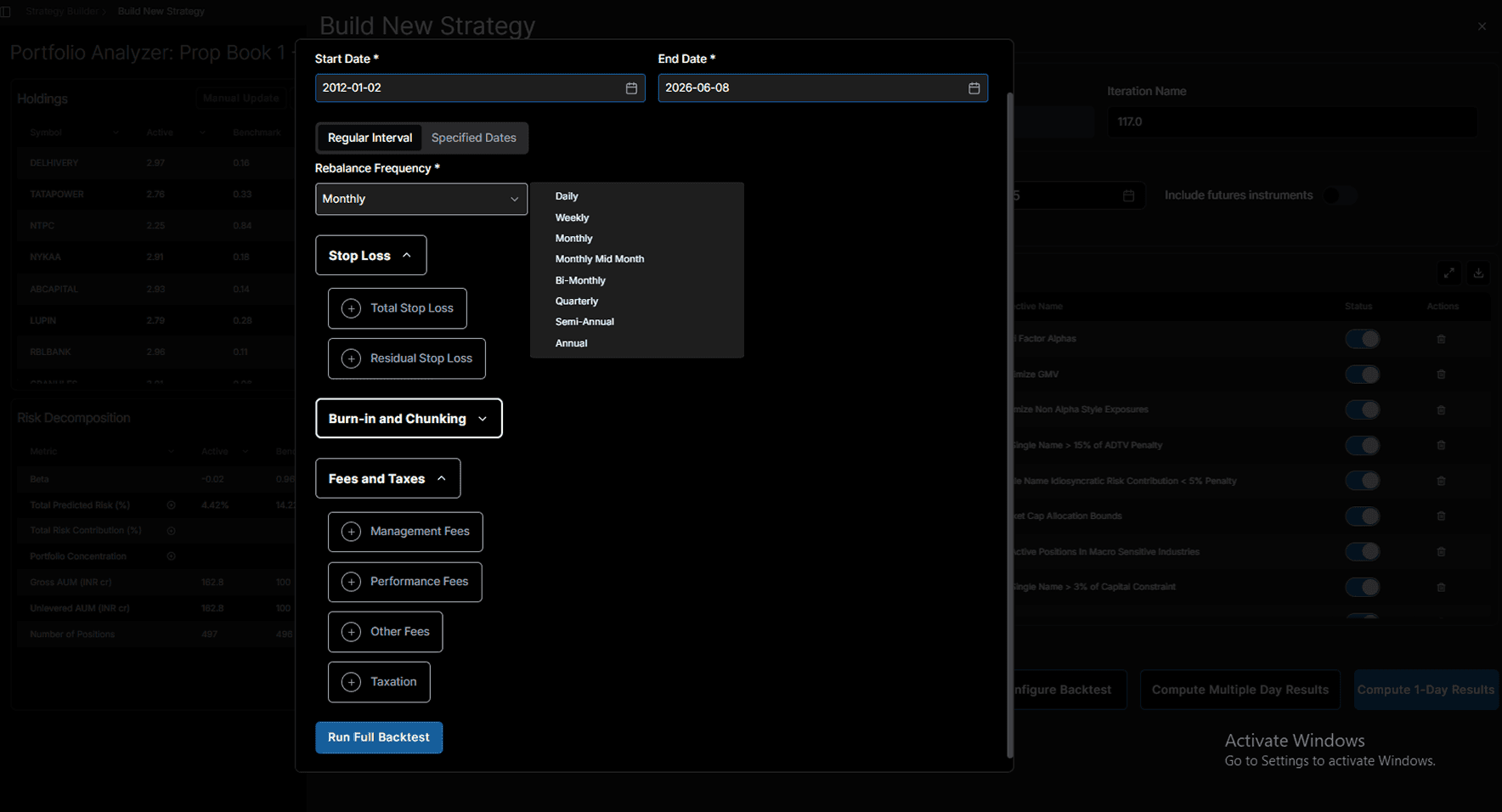
Backtest & Validate Strategies
Run in-sample backtests across configurable date ranges and rebalance frequencies to evaluate historical strategy performance under realistic portfolio construction rules.
Analyse detailed performance, attribution, risk, and portfolio analytics while leveraging Alpha Machine screeners and factors throughout the research and validation process.

Deploy To Production
Move validated strategies from research into production once portfolio characteristics, exposures, turnover, and attribution results meet investment objectives.
Maintain a consistent workflow from portfolio design and testing through to implementation without rebuilding strategies across separate systems.

Accelerate Research With Sample Strategies
Start from a library of pre-populated portfolio construction templates, constraints, and objectives to reduce setup time and standardise research workflows.
Use sample strategies as starting points for fundamental enhancements, quantitative models, benchmark-aware portfolios, and custom investment mandates.